ISO 14001 internal audit checklist, by clause and by area.
134 checks for an environmental management system audit: clauses 4 to 10,
then the areas an auditor walks, from the waste area to management review. Each
has the records to sample, questions to ask and red flags. It works for ISO
14001:2015 systems today and marks what changes in ISO 14001:2026.
ISO 14001:2015 and 2026. Clause numbers follow 2015, with the 2026 number where it differs, and the 2026 changes are marked.
Organized by
Clause, then area. ISO 14001 is copyrighted, so every check is in our own words and clauses appear as numbers only.
Cost
Nothing. The checklist needs no email. The fillable Excel toolkit is free too; we ask for your name, company and email.
To print
Plan the audit program first
ISO 14001 does not set how often, how long or how deep each audit is. A
certification auditor will ask why each process gets the attention it
does. Answer with your risk rating: the environmental importance of the
process, what has changed and what earlier audits found. ISO 19011:2026
gives optional guidance on running a program. New to the subject? Start
with our glossary entry on internal audit.
List the processes and areas in scope, from waste handling and chemical storage to purchasing, contractors and management review.
Rate each one on its significant aspects, compliance obligations and permit conditions, recent incidents or complaints, and recent change.
Set frequency from the rating. A defensible default: every process once a year, higher-risk areas twice.
Assign auditors who do not audit their own work, and record their competence, including their grasp of the permits in the area.
Revisit the program after each audit, spill, exceedance, permit change or significant change to the site.
How to sample
Every audit is a sample; certification audit reports must say so. On an
environmental audit, the site walk is part of the sample: what you see in
the yard or the waste area is evidence too.
Walk the site first. Waste areas, chemical stores, drains, emission points, the yard and the loading dock. Compare what you see with the aspects register.
Follow a permit condition end to end: from the permit to the control, the monitoring record, the lab result and the report sent.
Pick the sample yourself. A sample the auditee hands you is a showcase.
Spread it across shifts, weekends, contractors, and old and recent records.
Start small, then expand. Start with three to five records. When one fails, take more: that tells a slip from a system failure.
Record what you sampled, by ID: permit and document numbers, drum and container IDs, dates and locations.
Free download · Excel + PDF
Get this checklist in Excel, plus the rest of your audit program
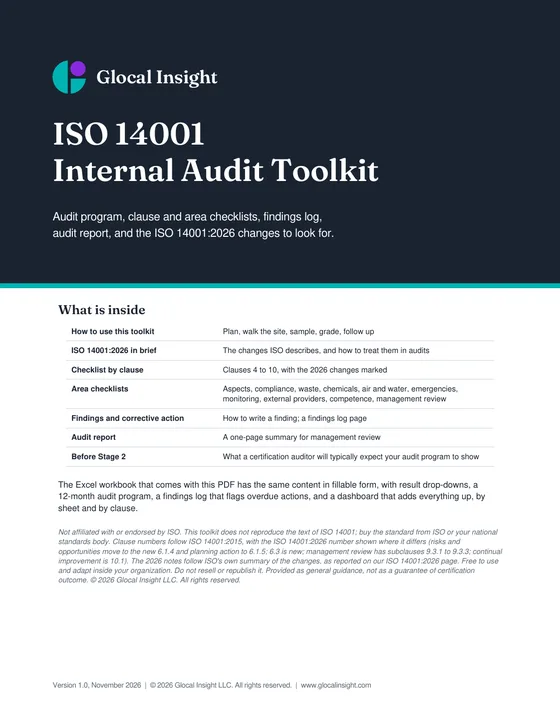
The ISO 14001 Internal Audit Toolkit: this checklist as an 18-sheet Excel workbook and a 16-page printable PDF, plus what goes around it.
A 12-month audit program and a one-page audit plan
The clause 4 to 10 checklist with result drop-downs, each clause noting what changes in ISO 14001:2026
Ten area checklists, from environmental aspects and waste to emergency preparedness and management review
A findings log that flags overdue corrective actions
A dashboard that totals findings and results by clause, and a one-page report for management review
Excel (.xlsx, no macros) and PDF. Free to use and adapt inside your organization. Not affiliated with ISO; it does not reproduce the standard.
Thanks. Your files are ready:
Save the Excel file before you fill it in, then open the Start Here sheet. Questions? Write to info@glocalinsight.com.
Use it as an aid, not a limit: follow the evidence where it leads.
Checkboxes are not saved, so print the page or save it as a PDF.
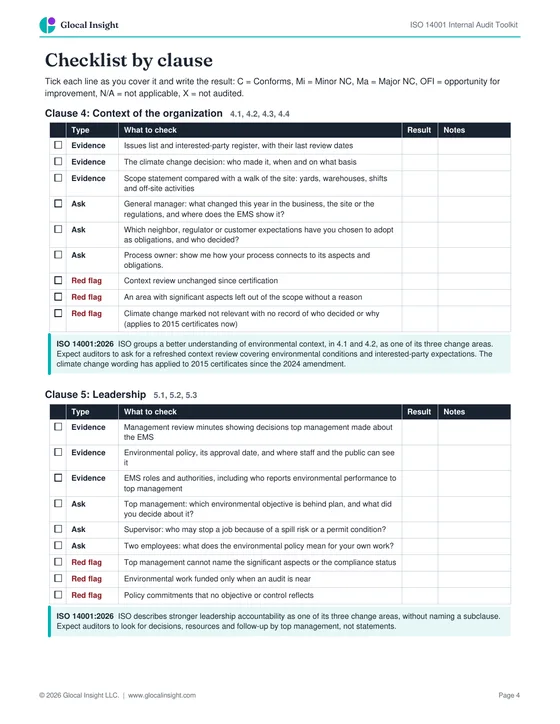
Clause 4: Context of the organization
Clauses: 4.1, 4.2, 4.3, 4.4
2026: ISO groups a better understanding of environmental context, in 4.1 and 4.2, as one of its three change areas. Expect auditors to ask for a refreshed context review covering environmental conditions and interested-party expectations. The climate change wording has applied to 2015 certificates since the 2024 amendment.
2026: ISO describes stronger leadership accountability as one of its three change areas, without naming a subclause. Expect auditors to look for decisions, resources and follow-up by top management, not statements.
Clauses: 6.1.1 to 6.1.4, 6.2 (2026: 6.1.1 to 6.1.5, 6.2, 6.3)
2026: ISO describes decision-making as more structured, with a clearer framework for risks and opportunities supported by a new clause 6.1.4; planning action moves to 6.1.5. Clause 6.3 on planning changes is new. Risks and opportunities were already required in 2015 (6.1.1): expect auditors to look for a defined way of deciding which ones need action, and for changes assessed before they happen.
2026: ISO's summary names no change in clause 7. When you move to 2026, update documented information for the new clause numbers and replace outsourcing wording with externally provided processes, products and services.
2026: ISO replaces outsourcing with externally provided processes, products and services, extending oversight across the value chain beyond your own boundaries. Check that every external provider that can affect environmental performance is identified and has a control or influence set. ISO's summary names no change in 8.2.
2026: ISO says internal audit requirements are more rigorous, naming a documented audit program and audit objectives, and that management review is more structured; Global ACI's transition document notes new subclauses under 9.3. Compare your audit program, audit plans and review agenda with the 2026 text.
2026: Continual improvement is 10.1 in the 2026 edition (10.3 in 2015), and nonconformity and corrective action stays at 10.2. ISO's summary names no other change in clause 10. Update the clause references in your forms.
The same requirements, turned into questions for the places an EMS
auditor usually walks. Add the conditions of your own permits and site
rules. Lines marked 2026 explain what changes in the 2026 edition.
A1. Environmental aspects
Identifying aspects and deciding which are significant
A2. Compliance obligations
Permits, regulations, commitments and evaluation of compliance
A3. Waste
Operational control: waste streams, storage, haulers and records
A4. Chemicals and storage
Operational control: chemical approval, storage, containment and spills
A5. Air and water
Operational control: air emissions, wastewater, storm water, energy and water use
A6. Emergency preparedness
Emergency preparedness and response
A7. Monitoring and measurement
What is measured, with what, and what happens to the results
A8. External providers
Suppliers, contractors and externally provided processes
A9. Competence and awareness
Training, competence and awareness
A10. Management review
Inputs, conclusions, decisions and follow-up
From glocalinsight.com/resources/iso-14001-internal-audit-checklist/,
last verified November 11, 2026. Our own questions, not ISO text. The 2026
notes follow ISO's own summary as reported on our
ISO 14001:2026 page.
How to write a finding
ISO/IEC 17021-1 has certification auditors record a nonconformity
against a specific requirement, with a clear statement and the objective
evidence in detail, and without suggesting the cause or the fix. Hold
your internal findings to the same shape.
The requirement. An ISO 14001 clause, your own procedure, a permit condition or a regulation. No requirement, no nonconformity.
The evidence. Enough detail that someone else could find what you saw: IDs, dates, places.
The statement. A sentence or two about the system, not a retelling of the evidence.
Example
Requirement: 8.1 and procedure EP-06: hazardous waste containers are closed, dated and labeled with their contents, and kept in the designated area.
Evidence: In the waste area on the audit date, 2 of 9 drums sampled (W-14, W-17) had no accumulation start date; W-17 was open with a funnel left in it.
Statement: Hazardous waste containers are not consistently dated and closed as the procedure requires.
Do not soften a nonconformity into an observation. Where a finding is
also a breach of a permit or regulation, act on it at once and notify
where required, whatever the audit grade. Leave the cause and the fix to
the process owner. Our page on
major nonconformities
explains where minor ends and major begins.
Before Stage 2
Stage 1 checks that internal audits and management reviews are being
planned and performed, and Stage 2 examines both. Tick every line
before you book it. No one on staff independent of the work? Our
independent internal audits
fill that gap. How long will the certification audit take? Our
ISO audit days calculator estimates it.
What the certification body does with your internal audits
Accredited certification bodies work to ISO/IEC 17021-1:2015.
Initial certification. Stage 1 checks that internal audits and management reviews are planned and performed, and Stage 2 includes both.
Every audit report. It must state that the audit was based on a sample, and summarize the evidence on your internal audit and management review process.
Every surveillance audit. Internal audits and management review head the list of what each must include. Surveillance runs at least once a calendar year outside recertification years, the first within 12 months of the certification decision.
If a certification auditor finds in two days what your program missed in
a year, expect questions about the program itself. Our
internal auditor training covers
sampling and writing findings, and our
ISO 14001 consulting covers the rest of the system.
Moving to the 2026 edition
ISO 14001:2026 was published on April 15, 2026. Under Global ACI-TECH-3-TR,
new and initial accredited certifications may only be issued to the 2026
edition from October 31, 2027, and certificates to ISO 14001:2015 must be
transitioned by April 30, 2029. A transition audit reviews the changed
requirements, changes in your context and the need for any other changes
to your system. Before it, run our
ISO 14001:2026 gap analysis checklist,
then an internal audit that covers the changes. Every date is on our
ISO 14001:2026 page.
Common questions
What should an ISO 14001 internal audit checklist include?
The records to sample, the questions to ask the people doing the work, and the conditions that would be findings, for each clause and for the places the evidence lives: the waste area, the chemical store, the drains and emission points, contractors and the compliance records. A clause list on its own tells you what to look for, not where to find it.
How often do ISO 14001 internal audits have to be done?
ISO 14001 sets no fixed frequency. Auditors expect the program to reflect how environmentally important each process is, what has changed and what earlier audits found. A defensible default is every process in scope once a year, with areas that carry significant aspects, compliance risk or past findings audited more often.
Who can perform an ISO 14001 internal audit?
Anyone competent who is not auditing their own work: a trained employee from another department, a peer from another site, or an outside auditor. The auditor needs to understand environmental aspects and the compliance obligations of the area being audited, and certification auditors check that you defined that competence and that the audit was objective.
Is the internal audit the same as the evaluation of compliance?
No. The evaluation of compliance (9.1.2) checks, obligation by obligation, whether you meet your permits, regulations and other commitments. The internal audit (9.2) checks whether the EMS conforms and works, and that includes checking the evaluation of compliance is done and acted on. You can schedule them together, but keep separate records of each.
Do we need an internal audit before the certification audit?
Yes. Under ISO/IEC 17021-1, Stage 1 looks for evidence that your internal audits and management reviews are already running, and Stage 2 audits both. Every surveillance audit reviews them again.
Should we audit against ISO 14001:2015 or ISO 14001:2026?
Against the edition you are certified to, or about to be. Record gaps against the 2026 edition as transition actions, not nonconformities, and run an internal audit that covers the 2026 changes before your transition audit. Under Global ACI-TECH-3-TR, new and initial accredited certifications may only be issued to ISO 14001:2026 from October 31, 2027, and ISO 14001:2015 certificates must be transitioned by April 30, 2029.
Does this checklist reproduce ISO 14001?
No. ISO 14001 is copyrighted in both editions. Every check here is our own question and clauses appear as numbers only. Buy the standard from ISO or your national standards body and keep it open while you audit.
2026-11-11 — Published with the free ISO 14001 Internal Audit Toolkit (Excel and PDF). 134 checks in our own words: 71 by clause (4 to 10) and 63 across ten audit areas, with the ISO 14001:2026 changes marked. Checked today: Global ACI-TECH-3-TR for ISO 14001:2026 (October 31, 2027; April 30, 2029; what a transition audit reviews; clause 6.3 and the 9.3 subclauses) and ISO/IEC 17021-1 Section 9 (IAS summary). iso.org and ANAB could not be reached today: ISO's change summary is as re-read on November 11 for our ISO 14001:2026 gap analysis checklist, and ANAB Heads Up 563 as verified on our ISO 14001:2026 page on November 9.