
Free checklist · Printable · Excel workbook below
ISO 14001:2026 gap analysis checklist, clause by clause.
87 checks across clauses 4 to 10, with the evidence to look for, written in our own words. The changes ISO itself describes for the 2026 edition are marked on the 32 checks they touch, starting with the two new clauses, 6.1.4 and 6.3.
Last verified November 17, 2026
- For
- Systems certified to ISO 14001:2015 moving to 2026, and new systems built to 2026.
- Deadline
- April 30, 2029 to transition; new certifications are 2026-only after October 31, 2027.
- Cost
- Nothing. The checklist needs no email. The fillable Excel workbook is free too; we ask for your name, company and email.
- To print
How to run the gap analysis
- Get the standard and keep it open. This checklist points to clause numbers and asks the questions an assessor would ask; it does not replace reading ISO 14001:2026.
- Start with the changes table below, and with clauses 6.3, which is new, and 6.1.4, where risks and opportunities now have a clause of their own.
- Work through the checks with the people who run each process, and walk the site. Record what you actually saw: document numbers, records, dates, the roles you spoke to and the areas you visited.
- Give every check a status: Meets, Partial, Gap or N/A. Partial usually means the practice exists but the evidence does not; that is a cheaper fix than a real gap.
- Turn every Partial and Gap into an action with an owner and a date, then plan the transition backward from the audit date you agree with your certification body.
- Run one internal audit and a management review after the changes are in place, before the transition audit.
Every transition date, what ISO says changed and how the transition audit works are on our ISO 14001:2026 reference page, which we keep current.
What changed in ISO 14001:2026
These are the changes ISO itself describes for the 2026 edition, as reported on our ISO 14001:2026 page. C1 to C6 are marked on the checks below. Start with C3 and C4: clause 6.3 is new, and 6.1.4 gives risks and opportunities a clause of their own. C7 and C8 name no single clause, so no check carries them.
| Code | Clause | What changed | What to do |
|---|---|---|---|
| C1 | 4.1, 4.2 | Environmental context. ISO groups the first change area as a better understanding of environmental context, concentrated in clauses 4.1 and 4.2. | Re-run your context review against the 2026 text: issues, environmental conditions, interested parties and which of their expectations you adopt. |
| C2 | 5 | Leadership accountability. ISO describes stronger leadership accountability as one of three change areas. Its summary names no subclause; the checks marked C2 are in 5.1. | Plan how top management will show accountability with decisions and records, not statements. Brief them before the transition audit. |
| C3 | 6.1.4 | New clause on risks and opportunities. ISO says decision-making becomes more structured: risks and opportunities get a clause of their own, the new 6.1.4 (in the 2015 edition they sat in 6.1.1), and change is formalized in 6.3. Planning action moves to 6.1.5. | Write down the criteria for deciding which risks and opportunities need action, apply them before decisions, and record which criteria each decision turned on. |
| C4 | 6.3 | New clause on change management. ISO names a new clause 6.3 on change management. Change was previously dealt with in fragments across clauses 6 and 8.1. | Set up one way to assess the environmental consequences of a change before it happens, including small operational changes. Apply it to the next change. |
| C5 | 8.1 | Externally provided processes, products and services. ISO says the shift from outsourcing to externally provided processes, products and services extends oversight across the value chain, beyond the organization's own boundaries. | Map every external provider to what it supplies and set a control or influence for each. Update procedures that still speak of outsourcing. |
| C6 | 9.2, 9.3 | Internal audit and management review. ISO says internal audit requirements are more rigorous, naming a documented audit program and audit objectives, and that management review is more structured; Global ACI's transition document notes new subclauses under 9.3. | Compare your audit program, audit plans and management review agenda with 9.2 and 9.3 of the 2026 text, line by line. |
| C7 | Throughout | Focus on outcomes. ISO describes a clearer focus on outcomes rather than on process for its own sake. It names no single clause, so no check is marked C7. | When you assess each clause, ask what result it delivers. Keep evidence of environmental performance, not only of activity. |
| C8 | Annex A | Annex A and clarity. ISO says Annex A plays a more active role in clarifying key concepts, and that clarity is improved throughout. Annex A is informative: it explains the requirements and adds none. | Read Annex A alongside the clauses you are changing, and update any guidance or training material that explained the old wording. |
Read before you start
- The codes C1 to C8 follow ISO's own published summary of what changed. A check carries a code only where that summary names its clause or area. The 2026 text decides: read it alongside this workbook.
- Clause 6.3 is new. Clause 6.1.4 is a new clause number, but risks and opportunities were already required in 2015 (6.1.1); what changes is a clearer framework for them. Expect auditors to spend time on both.
- Numbering moves: 6.1.4 Risks and opportunities is new, so planning action is now 6.1.5; management review has subclauses 9.3.1 to 9.3.3; continual improvement is 10.1. Update cross-references in your documents.
- Withdrawal of ISO 14001:2015 on April 15, 2026, did not invalidate certificates. Under Global ACI-TECH-3-TR, accredited 2015 certifications stay valid until April 30, 2029, and not after it; for SCC-accredited certificates in Canada, the 2015 edition is obsolete on April 16, 2029.
- If you also hold ISO 9001, plan both transitions together: both standards share the harmonized structure, so context, interested parties, leadership, planning, internal audit and management review are common ground.
Free download · Excel + PDF
Get these checks in Excel, with the dashboard
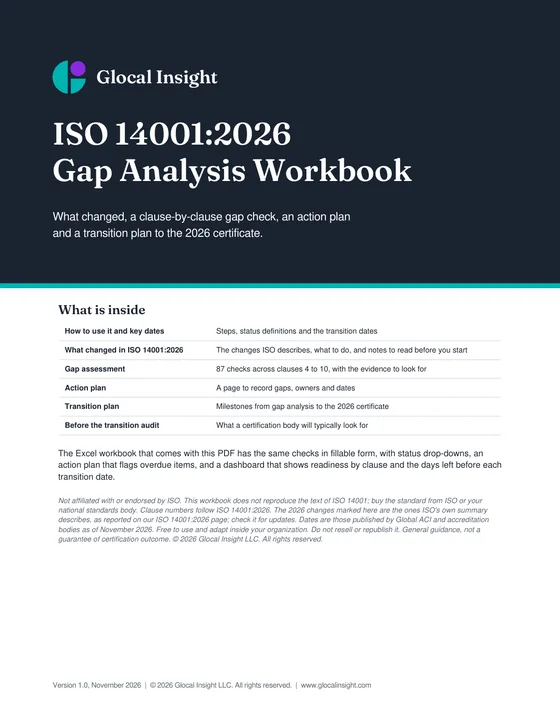
The ISO 14001:2026 Gap Analysis Workbook: this checklist as a 7-sheet Excel workbook and a printable PDF, with what goes around it.
- All 87 checks with Meets, Partial, Gap and N/A drop-downs and room for what you found
- The 2026 changes as a tracker, with owners and due dates
- An action plan that flags overdue actions, and a transition plan with the days left to each deadline
- A dashboard that shows readiness by clause, ready for your management review
- What a certification body will typically look for at your transition audit
Excel (.xlsx, no macros) and a printable PDF. Free to use and adapt inside your organization. Not affiliated with ISO; it does not reproduce the standard.
Thanks. Your files are ready:
Save the Excel file before you fill it in, then open the Start Here sheet. Questions? Write to info@glocalinsight.com.
Want a second pair of eyes on your gaps before the transition audit? See our ISO 14001 consulting
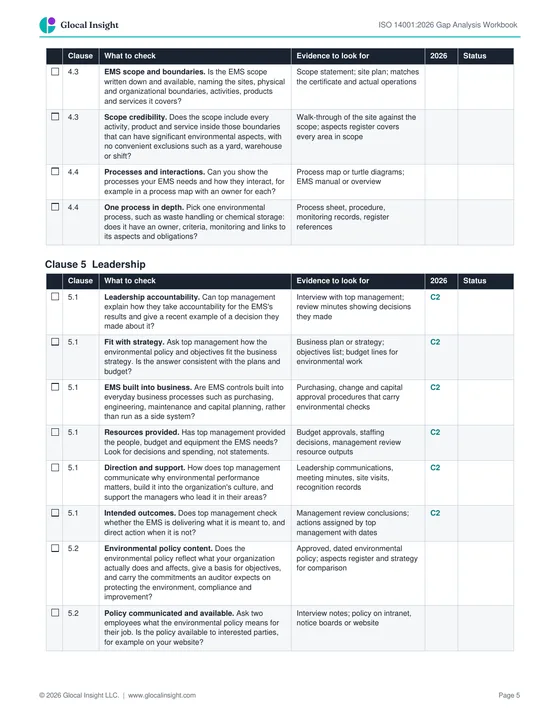
The checklist
Assessed by: ____________________ Area / site: ____________________ Date: __________
Tick each check as you cover it and note the status: Meets, Partial, Gap or N/A. Checks marked with a code fall in a change ISO names for the 2026 edition. Checkboxes are not saved, so print the page or use the Excel workbook.
Clause 5: Leadership
Clause 6: Planning
Clause 7: Support
Clause 8: Operation
Clause 9: Performance evaluation
Clause 10: Improvement
From glocalinsight.com/resources/iso-14001-2026-gap-analysis-checklist/, last verified November 17, 2026. Our own questions, not ISO text. Clause numbers follow ISO 14001:2026.
Before the transition audit
What a certification body will typically look for. Its own transition procedure and Global ACI's rules decide what is required.
Free tools and downloads
- ISO audit days calculatorEstimate certification audit days for ISO 9001, 14001 and 45001, alone or integrated.
- ISO 9001 and 14001:2026 transition deadline calculatorYour real transition deadline and a working-back plan from your certificate dates.
- ISO 14001 internal audit toolkitClause and area checklists from aspects and waste to management review, with the 2026 changes marked.
- What 32 major manufacturers require of suppliersWhich customers require a certificate, which only expect one, and which ask for a system.
- Building performance standards by cityNYC Local Law 97, Boston BERDO, DC BEPS and more: who is covered, deadlines, penalties, and where ISO 14001 fits.
Common questions
What is an ISO 14001:2026 gap analysis?
A comparison of what your environmental management system does today against the 2026 edition, ending in a list of what is missing, what needs work and what already holds up. For a system certified to ISO 14001:2015 most of the work already exists; the effort goes into the changes and into showing evidence for them.
What changed in ISO 14001:2026?
ISO's own summary groups the changes into three areas: a better understanding of environmental context in clauses 4.1 and 4.2, stronger leadership accountability, and a clearer focus on outcomes. It says decision-making is more structured, with a new clause 6.1.4 giving risks and opportunities a clause of their own and a new clause 6.3 on planning changes, the replacement of outsourcing with externally provided processes, products and services, strengthened internal audit and management review requirements, and a more active role for Annex A.
When do we have to transition?
Under Global ACI-TECH-3-TR, organizations certified to ISO 14001:2015 must complete their transition by April 30, 2029, and after October 31, 2027, new and initial accredited certifications may only be issued to ISO 14001:2026. ANAB adopted those dates for the certification bodies it accredits in Heads Up 563 on October 1, 2026. For SCC-accredited certificates in Canada, ISO 14001:2015 becomes obsolete on April 16, 2029.
Which parts take longest?
Clause 6.3, which is new, and clause 6.1.4, where risks and opportunities now have a clause of their own. Planning changes before they happen and showing how risks and opportunities feed real decisions are habits rather than documents, and an auditor will want records that show them working. Updating clause references and the wording on externally provided processes is quick by comparison.
Can we do the gap analysis ourselves?
Yes. Use someone who does not run the process being checked, keep the standard open, walk the site and record the evidence you saw. The most useful thing to get right is the difference between a process gap and an evidence gap: most organizations already do much of what the standard asks but cannot show it. If you would rather have an independent assessor do it, that is one of our services.
Does this checklist reproduce ISO 14001:2026?
No. ISO 14001:2026 is copyrighted. Every check here is our own question and clauses appear as numbers only. Buy the standard from ISO or your national standards body and use it alongside this checklist.
What is in the free Excel workbook?
The same 87 checks with Meets, Partial, Gap and N/A drop-downs and a place to record what you found; the 2026 changes as a tracker; an action plan that flags overdue actions; a transition plan with the days left to each deadline; a dashboard that shows readiness by clause; and the before-audit list. A printable PDF comes with it. It asks for your name, company and email.
We hold ISO 9001 too. Is there a checklist for that?
Yes: the ISO 9001:2026 gap analysis checklist on this site works the same way. Both standards share the harmonized structure, so context, interested parties, leadership, planning, internal audit and management review are common ground. Plan the two transitions together rather than paying twice for the same work.
Sources
- ISO, what's changed in ISO 14001:2026 — the change areas and clause additions behind C1 to C8.
- Global ACI-TECH-3-TR 2029-04-30 (M), Transition Requirements for ISO 14001:2026 — October 31, 2027, and April 30, 2029.
- ANAB Heads Up 563, October 1, 2026 — ANAB adopts the Global ACI transition document.
- UKAS, ISO 14001:2026 transition bulletin, Revision 2, October 7, 2026 — the same dates for UKAS-accredited certification bodies.
- SCC Bulletin 2026-21 — Canada: the 2015 edition is obsolete for SCC-accredited certification from April 16, 2029.
- ISO 14001:2026: the deadline and what changed — our maintained page, the evidence for every code here.
Changelog
- 2026-11-17 — Re-verified, no changes. Global ACI's ISO 14001:2026 transition document unchanged (October 31, 2027, and April 30, 2029), UKAS EMS bulletin still Revision 2 of October 7, SCC Bulletin 2026-21 unchanged (April 16, 2029), and ISO 14001:2026 at stage 60.60 with no amendment (re-checked November 17; ISO and ANAB again November 19).
- 2026-11-11 — Published. 87 checks across clauses 4 to 10, written in our own words, with clause numbers following the ISO 14001:2026 table of contents and the changes ISO itself describes marked (C1 to C8). Dates re-checked today on Global ACI-TECH-3-TR (October 31, 2027, and April 30, 2029), the UKAS EMS bulletin (Revision 2, October 7) and SCC Bulletin 2026-21 (April 16, 2029). ISO's change summary was re-read today and the C3 and C6 descriptions corrected to match it; ANAB Heads Up 563 is as last verified on our ISO 14001:2026 page on November 9. The same checks are in the free Excel and PDF workbook.