
Free checklist · Printable · Excel workbook below
ISO 9001:2026 gap analysis checklist, clause by clause.
88 checks across clauses 4 to 10, with the evidence to look for, written in our own words against the published standard. The 11 confirmed 2026 changes are marked on the 21 checks they touch.
Last verified November 4, 2026
- For
- Systems certified to ISO 9001:2015 moving to 2026, and new systems built to 2026.
- Written against
- Our licensed copy of ISO 9001:2026. It is copyrighted, so clauses appear as numbers only.
- Cost
- Nothing. The checklist needs no email. The fillable Excel workbook is free too; we ask for your name, company and email.
- To print
How to run the gap analysis
- Get the standard and keep it open. This checklist points to clause numbers and asks the questions an assessor would ask; it does not replace reading ISO 9001:2026.
- Start with the changes table below. It tells you which parts of your system need new work and which popular claims you can ignore.
- Work through the checks with the people who run each process. Record what you actually saw: document numbers, records, dates and the roles you spoke to, not what the procedure says should happen.
- Give every check a status: Meets, Partial, Gap or N/A. Partial usually means the practice exists but the evidence does not; that is a cheaper fix than a real gap.
- Turn every Partial and Gap into an action with an owner and a date, then plan the transition backward from the audit date you agree with your certification body.
- Run one internal audit and a management review after the changes are in place, before the transition audit.
The deadlines and the order of events are on our ISO 9001:2026 transition tracker, and what to do in each phase is on the transition checklist.
What changed in ISO 9001:2026
These are the changes we confirmed in the published text; each code is marked on the checks below. Start with C3 and C4: they take longest to evidence. C10 and C11 are mainly document updates, and C1 is not new but applies to your 2015 certificate today. The evidence behind each one is in what changed in ISO 9001:2026, every claim checked.
| Code | Clause | What changed | What to do |
|---|---|---|---|
| C1 | 4.1 | Climate change. Deciding whether climate change is a relevant issue came in with the 2024 amendment and carries over unchanged. It is not new in 2026: it already applies to 2015 certificates, so a missing decision is a nonconformity today. | Record your climate relevance decision in the context review. Check whether interested parties have climate-related expectations. |
| C2 | 4.2 c) | Interested-party requirements in scope. The one new item in Clause 4: you decide which relevant interested-party requirements the QMS will address. | Add an 'addressed by the QMS' decision and rationale to each requirement in your interested-party register. |
| C3 | 5.1.1 | Quality culture and ethics. Top management is now expected to promote a culture of quality and ethical behavior. | Plan visible leadership actions on culture and ethics. Pick one or two indicators to show whether they work. |
| C4 | 6.1.1-6.1.3 | Risks and opportunities restructured. 6.1 now has three subclauses (2015 had two): determining risks and opportunities (6.1.1), actions on risks (6.1.2) and actions on opportunities (6.1.3). Risks and opportunities must be analyzed and evaluated, and each type of action needs its own effectiveness evaluation. | Define and apply an analysis and evaluation method (writing it down is good practice). Track opportunities separately from risks and evaluate the effectiveness of each set of actions. |
| C5 | 6.3 | Planning of changes. The points to consider when planning a QMS change grow from four to seven, adding how the change is communicated, how its effectiveness is monitored and how its results are reviewed. | Update your change planning form or procedure with the three new points. Apply it to the next QMS change. |
| C6 | 7.3 | Awareness of culture and ethics. Awareness now includes the organization's quality culture and ethical behavior. | Add culture and ethics to induction and refresher briefings. Check understanding in internal audit interviews. |
| C7 | 8.2.1 e) | Contingency communication. 8.2.1 e) now covers telling customers about contingency actions for disruptions. 2015 already had a contingency item here, so update it rather than create a new one. | Add a customer communication step to your contingency plans: what is said, by whom and when. |
| C8 | 8.4.1 c) | Processes performed by providers. Control of externally provided processes now extends to any process an external provider performs, not only classic outsourcing. | Map every external provider to the processes it performs for you. Set a control method for each one. |
| C9 | 9.1.3, 9.3.2 | Separate review of actions. Analysis and evaluation, and management review, now treat actions on risks and actions on opportunities separately. | Split the risk and opportunity item into two in your analysis report and management review agenda. |
| C10 | 10.1, 10.2 | Clause 10 restructured. Clause 10 now has 10.1 Continual improvement, which absorbs the former 10.1 General and 10.3, and 10.2 Nonconformity and corrective action. The content is consolidated rather than new. | Update clause references in your manual, procedures, forms and audit checklists. Keep a cross-reference table. |
| C11 | 2, 3 | Vocabulary references. ISO 9000 remains the normative source for quality vocabulary, cited undated in Clause 2. Clause 3 defines a limited set of core terms. | Update standard and edition references and any glossary in your documented information to match. |
Popular claims that are not new requirements
- In the clauses, digital systems appear only in a note to 7.1.6; Annex A discusses technology informatively. There is no new requirement for digital transformation or AI.
- Emerging technologies appear only as an example in a note to 6.1.3.
- Disruption appears in a note to 6.1.2. There is no supply-chain-resilience or organizational-resilience requirement.
- Culture appears in a note to 7.1.4 on the process environment. The culture requirements sit in 5.1.1 and 7.3.
- No new cybersecurity or data integrity requirement. The 7.5.3 wording on protecting documented information is unchanged, and 9.2 adds nothing on cybersecurity.
- No ESG or sustainability requirement beyond climate, and no expanded stakeholder engagement beyond the 4.2 c) scoping decision.
- Annex A explains structure, terms and intent and adds no requirements. Annex B has been removed.
- 5.2.1 e) lists the policy's fit with context and strategic direction as its own item. The 2015 edition already required this in substance, in 5.2.1 a).
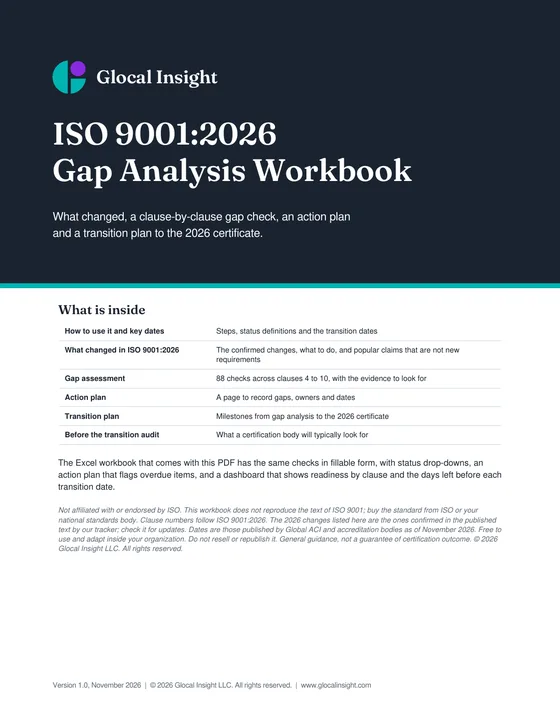
Free download · Excel + PDF
Get these checks in Excel, with the dashboard
The ISO 9001:2026 Gap Analysis Workbook: this checklist as a 7-sheet Excel workbook and a printable PDF, with what goes around it.
- All 88 checks with Meets, Partial, Gap and N/A drop-downs and room for what you found
- The 2026 changes as a tracker, with owners and due dates
- An action plan that flags overdue actions, and a transition plan with the days left to each deadline
- A dashboard that shows readiness by clause, ready for your management review
- What a certification body will typically look for at your transition audit
Excel (.xlsx, no macros) and a printable PDF. Free to use and adapt inside your organization. Not affiliated with ISO; it does not reproduce the standard.
Thanks. Your files are ready:
Save the Excel file before you fill it in, then open the Start Here sheet. Questions? Write to info@glocalinsight.com.
Want a second pair of eyes on your gaps before the transition audit? See our ISO 9001:2026 transition support
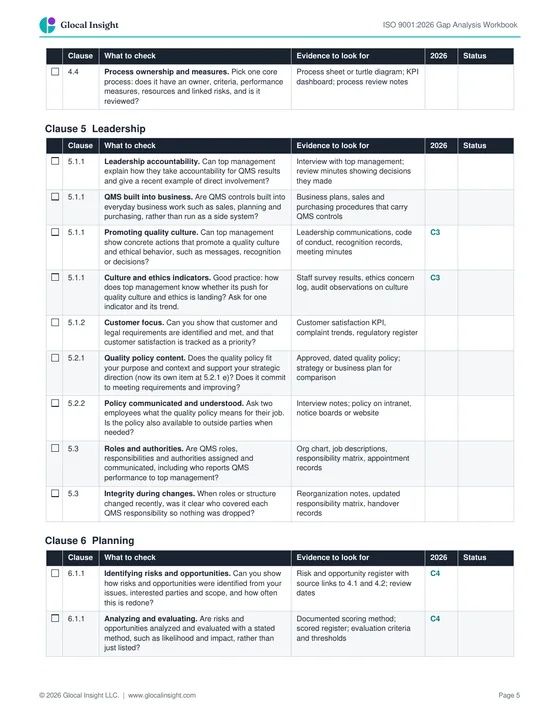
The checklist
Assessed by: ____________________ Area / site: ____________________ Date: __________
Tick each check as you cover it and note the status: Meets, Partial, Gap or N/A. Checks marked with a code are the 2026 changes. Checkboxes are not saved, so print the page or use the Excel workbook.
Clause 5: Leadership
Clause 6: Planning
Clause 7: Support
Clause 8: Operation
Clause 9: Performance evaluation
Clause 10: Improvement
From glocalinsight.com/resources/iso-9001-2026-gap-analysis-checklist/, last verified November 4, 2026. Our own questions, not ISO text. Clause numbers follow ISO 9001:2026.
Before the transition audit
What a certification body will typically look for. Its own transition procedure and Global ACI's rules decide what is required.
Want an independent read before your certification body's? We run ISO 9001:2026 gap analyses and transition projects for manufacturers and service companies; see ISO 9001:2026 transition support or get in touch. That first conversation is free.
Common questions
What is an ISO 9001:2026 gap analysis?
A comparison of what your quality management system does today against the 2026 edition, ending in a list of what is missing, what needs work and what already holds up. For a system certified to ISO 9001:2015 most of the work is already done; the effort goes into the confirmed changes and into showing evidence for them.
Do we have to do one to transition?
Treat it as the first step of your transition plan rather than a form you must file. The transition audit tests your system against the 2026 edition, so a gap analysis is the cheapest way to find what the auditor would find first, and your certification body may ask how you planned the transition.
How long does it take?
Less than a first-time gap analysis, because most of the system already exists. Plan for a few working days of interviews and record sampling spread over one or two weeks, then the time to close what you find. The changes to risks and opportunities (6.1) and to quality culture and ethics (5.1.1 and 7.3) usually take longest to evidence.
Can we do the gap analysis ourselves?
Yes. Use someone who does not run the process being checked, keep the standard open, and record the evidence you saw. The most useful thing to get right is the difference between a process gap and an evidence gap: most organizations already do much of what the standard asks but cannot show it. If you would rather have an independent assessor do it, that is one of our services.
Does this checklist reproduce ISO 9001:2026?
No. ISO 9001:2026 is copyrighted. Every check here is our own question, written against our licensed copy of the published text, and clauses appear as numbers only. Buy the standard from ISO or your national standards body and use it alongside this checklist.
What is in the free Excel workbook?
The same 88 checks with Meets, Partial, Gap and N/A drop-downs and a place to record what you found; the 2026 changes as a tracker; an action plan that flags overdue actions; a transition plan with the days left to each deadline; a dashboard that shows readiness by clause; and the before-audit list. A printable PDF comes with it. It asks for your name, company and email.
When do we have to transition?
Accredited ISO 9001:2015 certificates are not valid after September 30, 2029, and from March 31, 2028, new and initial accredited certifications are issued to the 2026 edition only (Global ACI-TECH-3-TR). In the US, a certification body can issue ANAB-accredited 2026 certificates only after ANAB has decided its transition. Our transition tracker keeps all the dates current.
Sources
- ISO launch announcement, September 16, 2026 — ISO 9001:2026 published.
- Global ACI-TECH-3-TR, transition requirements for ISO 9001:2026 — March 31, 2028 and September 30, 2029.
- ANAB Heads Up 564, October 9, 2026 — accredited 2026 certificates only after a certification body's transition.
- SCC Bulletin 2026-23, September 25, 2026 — Canada: the 2015 edition is obsolete for SCC-accredited certificates from September 15, 2029.
- What changed in ISO 9001:2026, every claim checked — our evidence for C1 to C11.
Changelog
- 2026-11-04 — Published. 88 checks across clauses 4 to 10, written in our own words against our licensed copy of ISO 9001:2026, with the confirmed changes marked (C1 to C11) and the popular claims that are not new requirements. The same checks are in the free Excel and PDF workbook.